Originally Written on October 18, 2021 for JOUR-303: Covering the City with Theresa Vargas
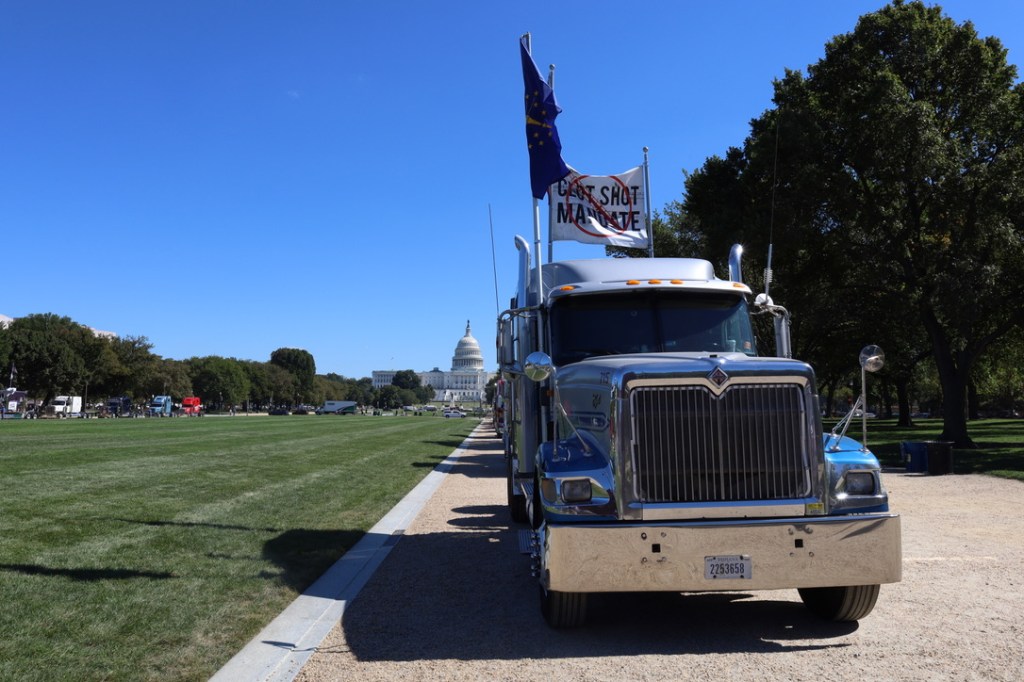
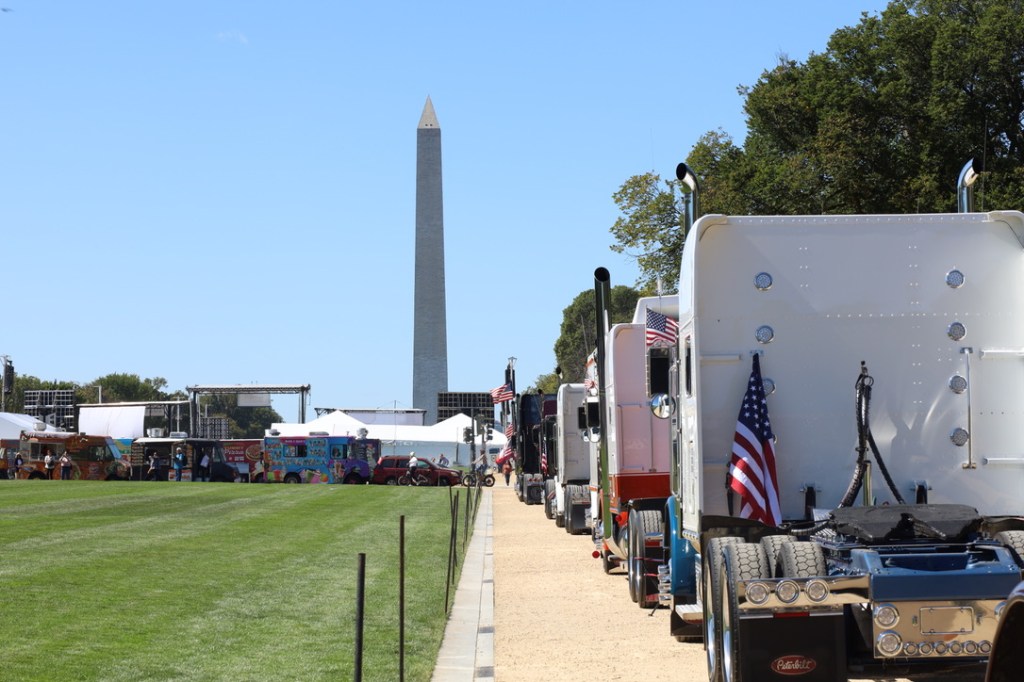
There was an abundance of sleeveless flannels, blue jeans and mesh hats. Sitting in long, organized lines, 41 semitrucks of all shapes and sizes sat flying large American flags, rolling coal, and spewing black diesel smoke into the bright blue sky. A normal sight at an interstate rest-stop or highway weigh-station—but this was the National Mall.
On Oct. 1, truck drivers parked their vehicles between the United States Capitol Building and the Washington Monument to celebrate Ten Four D.C. Ten Four D.C. is a public awareness event now in its fourth year that draws attention to the importance of trucking in America, highlights the struggles that drivers face and allows the public to see these massive machines up close. This year’s event in particular seeks to reveal flaws in the Trillion dollar Infrastructure Investment and Jobs Act currently sitting in congress, and how it ignores trucking’s vital industry.
“It’s pretty cool to see these trucks on our national stage right here. This is where we get to help the public learn about our industry and what we do and how we do it,” said Robert Palm, a 60-year-old man from Albuquerque, N.M., who runs the charity Truckers Final Mile, which helps truckers that were injured, disabled or killed on the job reunite with their families and find financial support. He has also been an active truck driver for 40 years.
“People need to know that we’re not villains, we are essential. There’s nothing in your home—including your home—that hasn’t in one way, form, or another been touched by a truck,” said Palm.
Palm is, in one way or another, correct. The American Trucking Association reports that trucking moves 72.5% of all American freight, resulting in just under $800 billion in revenue. However, as a $1.2 Trillion infrastructure bill stalls in Congress, many truck drivers are disappointed by how their industry is completely ignored by the legislation.
“They took money for parking out of the infrastructure bill,” said Palm with a shake of his head, “Currently, across the country, many of the truck stops are at full capacity on a regular basis. Getting in for parking after 4-or-5pm is extremely difficult unless you pay.”
“We need parking,” agreed Joyce Rice, 51, from Crockett County, Tenn. Rice sat outside her deep green Kenworth semi in a lawn chair of the same color, burning cigarettes and answering phone calls on her bluetooth headset. “We’ve always needed parking, and they won’t put any money into parking. We need rest areas. You’ve got trucks sitting on on-ramps, and off-ramps, illegally.”
A lack of parking does not just endanger semitruck drivers, it endangers everyone on the road. When these huge haulers have to park in unconventional places, they can easily be rear-ended or clipped by drivers out of control. Many drivers, however, are forced to pull-over at inconvenient times due to stringent regulations and time clocks.
In 2012, the United States Congress passed MAP21, a bill that revised how the country funds surface transportation infrastructure. In this legislation, the government mandated that all freight trucks must be installed with an Electronic-Logging-Device, or ELD, that connects to the engine and software of the vehicle. These devices enforce a strict, fourteen hours-on, ten hours off schedule for drivers. One second over, and an alarm blares through the truck cabin.
“If you exceed your fourteen hour clock, it’s a violation and it goes directly to the Federal Motor Carrier Safety Administration (FMCSA) because the trucks are online,” said Rice, “You can’t even move to the side of a truck stop without violating your break.”
This inflexibility can be frustrating for all drivers. Rice and her posse of Benjamin Todd, 39; Stephanie Orem, 53 and Alex Brumley, 48, sat in a circle of lawn chairs, swayed to slow country music and listed their points of criticism
“If you’re parked at home and turn your key so you can mow the lawn underneath it, that starts that ELD. You gotta say why you drove the truck ten feet,” said Orem.
“They’re treating us like we’re machines. We’re not machines,” said Todd, a soft-spoken man with a large donut tattoo on his right shoulder. He would take sips of a large Sprite in between Lime-scooter rides.
Rice told one revealing story about her friend, Joni, who lived on a large property in Tennessee with a long driveway. One day, Joni hit her fourteen hour limit as she pulled into said driveway. Her ELD alarm started to blare, and legally, she could not drive her truck two miles back to her own home.
The ELD case is representative of a deeper problem in trucking: overregulation. Truckers are expected to know the four volumes of FMCSA regulations—over 26 pounds—by heart. Brumley said that truckers are more regulated than most airline pilots. One violation and a whole month’s paycheck might swirl down the drain. Even the officers who enforce the law, often don’t know the regulations in full, according to Rice.
“I’m the truck driver, he’s the enforcer, why doesn’t he know the law that he expects me to know,” she said, pointing to a sign on her truck reading, “Overregulation, much?”
Despite the aggressive amount of laws and guidelines, today you can get a Commercial Driving License (CDL) in as little as three weeks at the age of 18. Adults still unable to purchase alcohol can operate a 15-ton machine after less than one month of education.
“It’s like a puppy mill, how they just push people through,” said Brumley, “There’s a lack of training when it comes to enforcement officers. There’s a lack of training when it comes to drivers.”
However, this specific group of truck drivers is anything but untrained. At Ten Four D.C., everyone is passionate and informed about the trucking industry. Palm, Rice, Todd, Orem and Brumley each drive thousands of miles every year to change perceptions of the nation’s industrial lifeline. They want to expose issues that make the roads more dangerous, put vital supply chains at risk and threaten their ability to support their families.
“Just give us an ear,” said Palm, “Just listen.”
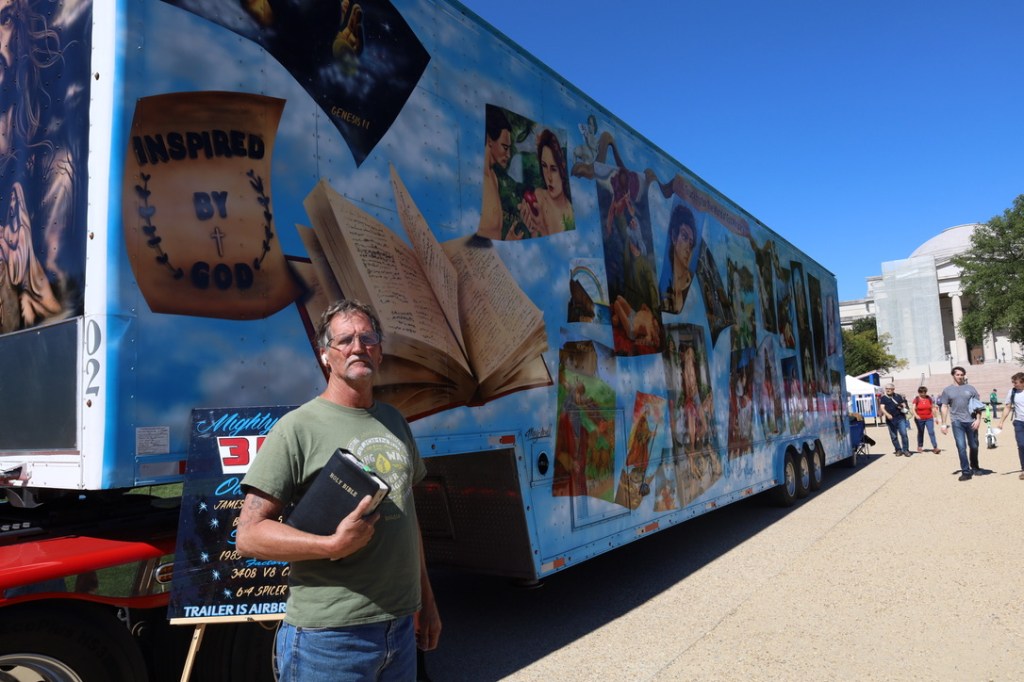
Other event attendees echoed Palm’s sentiment, including James Hodge, 59, from Chattanooga, Tenn. Hodge is a grizzly man with faded flame tattoos up both arms, a patchy white goatee and a heavily-marked bible in his hands at all times. He sits outside his bright red 1985 Peterbilt 359, pulling a trailer with ornate murals of biblical scenes and the words “Trucking for the Word of God.”
“Everything that we’ve got on a daily necessity, groceries, everything in your home, even pictures on your wall, everything at some time or another has been on a truck,” said Hodge, “Truck drivers are the backbone of America.”




 Hugh T. Brooks
Leave a comment